Showing posts with label on the edge. Show all posts

Tuesday, 4 December 2012

The Man with the Golden Arm (1955) - Star of the month... Frank Sinatra


'The Man with the Golden Arm' is a 1955 drama film directed by Otto Preminger and starring Frank Sinatra, Eleanor Parker, Kim Novak, Arnold Stang and Darren McGavin.

Based on the novel of the same name by Nelson Algren, the film tells of a heroin addict who becomes clean in prison, but then struggles with temptation after his release.

Former heroin addict Frankie Machine (played by Sinatra) is released from prison (where he has become clean) with a drum kit and a new lease on life. He returns to his wheelchair bound wife Zosh (played by Parker), and also runs into a former flame, Molly (played by Novak). Whilst out of jail, Frankie struggles to keep away from drugs, but later finds himself forced to deal in order to repay a debt.


Watch the trailer:


The title sequence

The film's controversial title sequence, designed by Saul Bass features the an animated paper cut out of a heroin addict's arms. The purpose of the cut out was to tap into the viewers emotions, and get them ready for the mood of the film.  Bass would later use a similar technique for Alfred Hitchcock films, 'Psycho' (1960), 'North by Northwest' (1959) and 'Vertigo' (1958).

Watch the title sequence:


Did you know...


  • The Motion Picture Association of America refused to certify the film because it was about a heroin addict - the film was released without the seal of approval
  • Marlon Brando was also considered for the role of Frankie Machine
  • In preparation for the film, Frank Sinatra spent time at drug rehabilitation centres to observe heroin addicts
  • According to Frank Sinatra Jr., the receiving hands of the second drug dealing belong to funny man Milton Berle


Award nominations


  • Academy Award nomination for Best Actor (Frank Sinatra)
  • Academy Award nomination for Best Art Direction/Set Decoration - Black & White
  • Academy Award nomination for Best Music Scoring of a Dramatic or Comedy Picture
  • BAFTA Award nomination for Best Film from any Source
  • BAFTA Award nomination for Best Foreign Actor (Frank Sinatra)
  • Satellite Award nomination for Outstanding Classic DVD (50th Anniversary Edition)


Closing remarks

'The Man with the Golden Gun' features one of Frank Sinatra's best dramatic roles. Otto Preminger broke ground by focusing on a taboo theme, such as heroin addiction, and persisting to release the film, even after it was refused classification. It helped shape censorship laws as a year later, films were permitted to depict drug use, kidnapping, prostitution and abortion.

Friday, 30 November 2012

All Fall Down (1962) - Star of the month Angela Lansbury


"I never know what I'm going to do next. I just follow the breeze. I just live for kicks." - Warren Beatty (as Berry-Berry Willart in 'All Fall Down')

'All Fall Down' is a 1962 drama directed by John Frankenheimer and starring Warren Beatty, Angela Lansbury, Karl Malden, Eva Marie Saint & Brandon deWilde.

Produced by John Houseman, the screenplay was written by William Inge, which was adapted from the novel by James Leo Herlihy.

Young drifter Berry-Berry Willart (played by Beatty) is a rebel with nowhere to go. He finds himself in and out of jail, and keeps away from his controlling mother, Annabel Willart (played by Lansbury) and father Ralph Willart (played by Karl Malden). His younger Clinton Willart (played by deWilde) idolises Berry-Berry, but soon discovers his nasty side when Echo (played by Saint), the daughter of a family friend stays with the Willarts.

Watch a short video about the film:

Family relationships

This film is all about family relationships.

The film's very first line informs the viewer the film is going to be about the relationship between two brothers, as Clinton says: "It seems that I've been on this crummy bus half my life, but I still think its worth it, because in a couple of minutes for the first time in over a year I'm going to see my brother Barry Barry".  At this point, Clinton idolizes and looks up to his older brother, Berry-Berry.

Also from the start of the film the viewer is informed of Berry-Berry's temper and wild behavior as we discover he is in jail. We are not informed of why he is in jail, which leads to suspense and curiosity as the we anxiously wait to find out. The waitress at the bar tells Clinton "if Berry-Berry was my brother, I wouldn't go around bragging about it", before escorting him to the door. Once we, along with Clinton finally meet Berry-Berry, Clinton tells him: "I don't want to go home. I want to stay with you".  Once we see what Clinton's home life is like with his parents, we can empathise with this statement.  Despite Clinton's strong admiration for his brother, the relationship between the two gradually deteriorates after Echo comes between the two.

Berry-Berry & Clinton's relationship with their mother is very different to most maternal relationships. They call their mother by her first name, Annabelle. Despite her controlling and to a degree manipulative ways, Annabelle does have good intentions. She loves her boys very much, and even makes Clinton pancakes for breakfast which he chooses to not eat. Instead opting to make his own breakfast.   At Christmastime, Annabelle is both surprised and grateful when Clinton gives her a gift. She asks him "For me?", as if she is doubting his generosity. In the film, Annabelle delivers one of my favourite statements: "Eavesdroppers never hear anything good about themselves." When you think about it, it's very true.

Clinton gives his mother Annabelle a Christmas gift - "For me?" she asks


Closing remarks

Overall, the film delivers a brilliant character study on family relationships, as well as tackling controversial issues such as female battery, adultery, and the female predator (cougar) prying on young men.  Despite taking 30 mins to introduce and develop the principle cast, the film is pure entertainment from the very beginning until the end. My favourite scene in the film occurs during Christmas time when Ralph invites 3 homeless tramps into their home, and Annabelle literally pays them $10 to leave.

Sunday, 28 October 2012

Cat on a Hot Tin Roof (1958) - Star of the month... Elizabeth Taylor


"Maggie the Cat is alive! I'm alive!" - Elizabeth Taylor (as Maggie in 'Cat on a Hot Tin Roof')

'Cat on a Hot Tin Roof' is a 1958 drama directed by Richard Brooks and starring Elizabeth Taylor, Paul Newman, Burt Ives, Judith Anderson, Jack Carson and Madeleine Sherwood.

Based on the Pulitzer prize-winning play by Tennessee Williams, it became one of the biggest box office hits of 1958.

Brick Pillitt is a former football player who breaks his ankle after he jumps hurdles under the influence of alcohol. As a result, Brick spends the rest of the film on a crutch. The next day, Brick and his wife Maggie (played by Taylor) visit Brick's family home for the 65th birthday of his father, Big Daddy (played by Ives). Also visiting are Brick's brother Gooper (played by Carson), his wife Mae (played by Sherwood) and their five bratty children. 

Watch the trailer:


Key relationships

The basic premise of the film is an in-depth examination of key relationships among the various family members. I will comment on the two key relationships, Maggie & Brick, and Brick & Big Daddy.

Firstly, the troubled relationship between husband and wife, Brick and Maggie. Brick's recently deceased best friend Skipper is also an important part of this relationship bringing about a love triangle. Tied into this relationship are the themes of sexual desire, and sexual repression. Maggie is desperate for Brick to make love to her, but Brick does not show any interest. Maggie is confused about what Brick's issue is, "Where did I fail you? Where did I make my mistake?" Although the couple live together, Maggie does not feel it. She tells Brick,"I'm not living with you! We occupy the same cage that's all!" 

Secondly, we have the detached relationship between Brick and his father. From the beginning of the film, we get a sense of some tension, but we don't know exactly what this is. Once we see Big Daddy and Brick talking in the cellar, Big Daddy asks Brick what he never gave him, to which Brick replies: "You can't buy love."

Key themes

Paul Newman & Elizabeth Taylor in an early
scene in the film
Key themes in the film include greed and death.

The film explores greed, and in particular family greed, with Gooper and Mae who use their five children and crawling tactics to scheme and take the family inheritance. Maggie fights back and tries to protect her husband's inheritance by lying she is pregnant.

The film also explores the concept of death, and the way in which the characters face death, particularly Big Daddy. At the start of the film, we learn Big Daddy has been sent away due to ill health. When he returns, we are told he has fully recovered. Shortly after, we learn the doctor had lied to Big Daddy, and he is in fact going to die. Once Big Daddy discovers the truth, we travel with him on his emotional response journey from denial, resistance, exploration to acceptance of his inevitable fate. Big Daddy even says to Brick: "I've got the guts to die. What I want to know is, have you got the guts to live?"

Censored for the screen

Tennessee Williams was angered by the way in which the strict Hays Production Code forced changes to his original play.  A notable component was the way in which the film adaptation limits Brick's sexual desire for Skipper, and removes the original play's critique on homophobia and sexism.

Did you know...


  • Burt Ives and Madeleine Sherwood reprise the roles they created on Broadway
  • Ben Gazzara played the role of Brick on Broadway, but turned down the role in the film
  • Don Murray was considered for the role of Brick
  • Elvis Presley turned down the role of Brick
  • Grace Kelly & Lana Turner were considered for the role of Maggie
  • George Cukor turned the chance to direct this film
  • Playwright Tennessee Williams disliked the film adaptation so much, he told people waiting to see the film to go home 
  • Due to a musicians union strike, the film lacks a traditional music score composed specifically for the film - instead the music score features pre-recorded pieces of music from the MGM music library, much of which was composed for the film 'Tension' (1949)
  • The film was originally meant to be filmed in black and white, however director Brooks insisted the film be in colour due to Elizabeth Taylor's violet coloured eyes, and Paul Newman's blue eyes
  • Burt Ives (who plays Big Daddy) was only one year older than Jack Carson, who plays his eldest son, and 16 years older than Paul Newman, who plays his youngest son


Award nominations

  • Academy Award nomination for Best Picture
  • Academy Award nomination for Best Actor (Paul Newman)
  • Academy Award nomination for Best Actress (Elizabeth Taylor)
  • Academy Award nomination for Best Cinematography
  • Academy Award nomination for Best Director
  • Academy Award nomination for Best Writing, screenplay based on another medium
  • BAFTA Award nomination for Best Film from any Source
  • BAFTA Award nomination for Best Foreign Actor (Paul Newman)
  • BAFTA Award nomination for Best Foreign Actress (Elizabeth Taylor)
  • Directors Guide of America nomination for Outstanding Directorial Achievement in Motion Pictures
  • Golden Globe nomination for Best Motion Picture - Drama
  • Golden Globe nomination for Best Motion Picture Director
  • Golden Lauren award for Top Female Dramatic Performance (Elizabeth Taylor)
  • Golden Lauren nomination for Top Male Dramatic Performance (Paul Newman)
  • National Board of Review Award winner for Top Ten Films
  • Writer's Guild of America Award nomination for Best Written American Drama

Closing remarks

'Cat on a Hot Tin Roof' is one of my favourite dramatic films, and is my favourite Elizabeth Taylor film. I like the way in which the film delves into family relationships and gradually unpacks the catalysts for the relationships throughout the film.

The entire cast delivers fantastic performers. In my opinion this is both the best performances Elizabeth Taylor and Paul Newman ever delivered. The only bad thing I can say about the acting is Australian actress Judith Anderson, occasionally loosing her accent and saying a few words here and there in an Australian accent. This may appear more obvious to me, as I am Australian, but other than, she does a great job.

I would consider 'Cat on a Hot Tin Roof' to be co-best film of 1958 with the MGM musical 'Gigi', which won the Best Picture Oscar (and is my second favourite film).


Friday, 31 August 2012

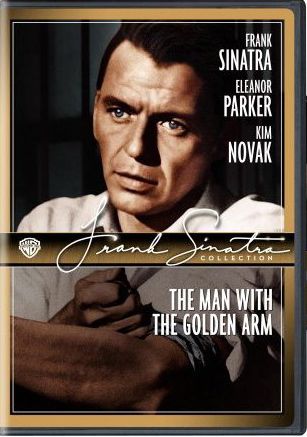
The Man with the Golden Arm (1955) - Spotlight on... On the Edge!


'The Man with the Golden Arm' is a 1955 drama film directed by Otto Preminger and starring Frank Sinatra, Eleanor Parker, Kim Novak, Arnold Stang and Darren McGavin.


Based on the novel of the same name by Nelson Algren, the film tells of a heroin addict who becomes clean in prison, but then struggles with temptation after his release.

Former heroin addict Frankie Machine (played by Sinatra) is released from prison (where he has become clean) with a drum kit and a new lease on life. He returns to his wheelchair bound wife Zosh (played by Parker), and also runs into a former flame, Molly (played by Novak). Whilst out of jail, Frankie struggles to keep away from drugs, but later finds himself forced to deal in order to repay a debt.


Watch the trailer:


The title sequence

The film's controversial title sequence, designed by Saul Bass features the an animated paper cut out of a heroin addict's arms. The purpose of the cut out was to tap into the viewers emotions, and get them ready for the mood of the film.  Bass would later use a similar technique for Alfred Hitchcock films, 'Psycho' (1960), 'North by Northwest' (1959) and 'Vertigo' (1958).

Watch the title sequence:


Did you know...


  • The Motion Picture Association of America refused to certify the film because it was about a heroin addict - the film was released without the seal of approval
  • Marlon Brando was also considered for the role of Frankie Machine
  • In preparation for the film, Frank Sinatra spent time at drug rehabilitation centres to observe heroin addicts
  • According to Frank Sinatra Jr., the receiving hands of the second drug dealing belong to funny man Milton Berle


Award nominations


  • Academy Award nomination for Best Actor (Frank Sinatra)
  • Academy Award nomination for Best Art Direction/Set Decoration - Black & White
  • Academy Award nomination for Best Music Scoring of a Dramatic or Comedy Picture
  • BAFTA Award nomination for Best Film from any Source
  • BAFTA Award nomination for Best Foreign Actor (Frank Sinatra)
  • Satellite Award nomination for Outstanding Classic DVD (50th Anniversary Edition)


Closing remarks

'The Man with the Golden Gun' features one of Frank Sinatra's best dramatic roles. Otto Preminger broke ground by focusing on a taboo theme, such as heroin addiction, and persisting to release the film, even after it was refused classification. It helped shape censorship laws as a year later, films were permitted to depict drug use, kidnapping, prostitution and abortion.

Sunday, 26 August 2012

Cat on a Hot Tin Roof (1958) - Spotlight on... On the Edge!


"Maggie the Cat is alive! I'm alive!" - Elizabeth Taylor (as Maggie in 'Cat on a Hot Tin Roof')

'Cat on a Hot Tin Roof' is a 1958 drama directed by Richard Brooks and starring Elizabeth Taylor, Paul Newman, Burt Ives, Judith Anderson, Jack Carson and Madeleine Sherwood.

Based on the Pulitzer prize-winning play by Tennessee Williams, it became one of the biggest box office hits of 1958.

Brick Pillitt is a former football player who breaks his ankle after he jumps hurdles under the influence of alcohol. As a result, Brick spends the rest of the film on a crutch. The next day, Brick and his wife Maggie (played by Taylor) visit Brick's family home for the 65th birthday of his father, Big Daddy (played by Ives). Also visiting are Brick's brother Gooper (played by Carson), his wife Mae (played by Sherwood) and their five bratty children. 

Watch the trailer:


Key relationships

The basic premise of the film is an in-depth examination of key relationships among the various family members. I will comment on the two key relationships, Maggie & Brick, and Brick & Big Daddy.

Firstly, the troubled relationship between husband and wife, Brick and Maggie. Brick's recently deceased best friend Skipper is also an important part of this relationship bringing about a love triangle. Tied into this relationship are the themes of sexual desire, and sexual repression. Maggie is desperate for Brick to make love to her, but Brick does not show any interest. Maggie is confused about what Brick's issue is, "Where did I fail you? Where did I make my mistake?" Although the couple live together, Maggie does not feel it. She tells Brick,"I'm not living with you! We occupy the same cage that's all!" 

Secondly, we have the detached relationship between Brick and his father. From the beginning of the film, we get a sense of some tension, but we don't know exactly what this is. Once we see Big Daddy and Brick talking in the cellar, Big Daddy asks Brick what he never gave him, to which Brick replies: "You can't buy love."


Key themes

Paul Newman & Elizabeth Taylor in an early
scene in the film
Key themes in the film include greed and death.

The film explores greed, and in particular family greed, with Gooper and Mae who use their five children and crawling tactics to scheme and take the family inheritance. Maggie fights back and tries to protect her husband's inheritance by lying she is pregnant.

The film also explores the concept of death, and the way in which the characters face death, particularly Big Daddy. At the start of the film, we learn Big Daddy has been sent away due to ill health. When he returns, we are told he has fully recovered. Shortly after, we learn the doctor had lied to Big Daddy, and he is in fact going to die. Once Big Daddy discovers the truth, we travel with him on his emotional response journey from denial, resistance, exploration to acceptance of his inevitable fate. Big Daddy even says to Brick: "I've got the guts to die. What I want to know is, have you got the guts to live?"


Censored for the screen

Tennessee Williams was angered by the way in which the strict Hays Production Code forced changes to his original play.  A notable component was the way in which the film adaptation limits Brick's sexual desire for Skipper, and removes the original play's critique on homophobia and sexism.


Did you know...


  • Burt Ives and Madeleine Sherwood reprise the roles they created on Broadway
  • Ben Gazzara played the role of Brick on Broadway, but turned down the role in the film
  • Don Murray was considered for the role of Brick
  • Elvis Presley turned down the role of Brick
  • Grace Kelly & Lana Turner were considered for the role of Maggie
  • George Cukor turned the chance to direct this film
  • Playwright Tennessee Williams disliked the film adaptation so much, he told people waiting to see the film to go home 
  • Due to a musicians union strike, the film lacks a traditional music score composed specifically for the film - instead the music score features pre-recorded pieces of music from the MGM music library, much of which was composed for the film 'Tension' (1949)
  • The film was originally meant to be filmed in black and white, however director Brooks insisted the film be in colour due to Elizabeth Taylor's violet coloured eyes, and Paul Newman's blue eyes
  • Burt Ives (who plays Big Daddy) was only one year older than Jack Carson, who plays his eldest son, and 16 years older than Paul Newman, who plays his youngest son


Award nominations

  • Academy Award nomination for Best Picture
  • Academy Award nomination for Best Actor (Paul Newman)
  • Academy Award nomination for Best Actress (Elizabeth Taylor)
  • Academy Award nomination for Best Cinematography
  • Academy Award nomination for Best Director
  • Academy Award nomination for Best Writing, screenplay based on another medium
  • BAFTA Award nomination for Best Film from any Source
  • BAFTA Award nomination for Best Foreign Actor (Paul Newman)
  • BAFTA Award nomination for Best Foreign Actress (Elizabeth Taylor)
  • Directors Guide of America nomination for Outstanding Directorial Achievement in Motion Pictures
  • Golden Globe nomination for Best Motion Picture - Drama
  • Golden Globe nomination for Best Motion Picture Director
  • Golden Lauren award for Top Female Dramatic Performance (Elizabeth Taylor)
  • Golden Lauren nomination for Top Male Dramatic Performance (Paul Newman)
  • National Board of Review Award winner for Top Ten Films
  • Writer's Guild of America Award nomination for Best Written American Drama

Closing remarks

'Cat on a Hot Tin Roof' is one of my favourite dramatic films, and is my favourite Elizabeth Taylor film. I like the way in which the film delves into family relationships and gradually unpacks the catalysts for the relationships throughout the film.

The entire cast delivers fantastic performers. In my opinion this is both the best performances Elizabeth Taylor and Paul Newman ever delivered. The only bad thing I can say about the acting is Australian actress Judith Anderson, occasionally loosing her accent and saying a few words here and there in an Australian accent. This may appear more obvious to me, as I am Australian, but other than, she does a great job.

I would consider 'Cat on a Hot Tin Roof' to be co-best film of 1958 with the MGM musical 'Gigi', which won the Best Picture Oscar (and is my second favourite film).


Alex in Wonderland (1971) - Spotlight on... On the Edge!


"Somewhere over the rainbow I'll get high..." - Donald Sutherland (as Alex Morrison in 'Alex in Wonderland')


'Alex in Wonderland' is a 1971 comedy-drama directed by Paul Mazursky and starring Donald Sutherland, Ellen Burstyn, Andre Philippe, Meg Mazursky, Viola Spolin and Paul Mazursky with special guest appearances from Federico Fellini and Jeanne Moreau. It was written by Paul Mazursky with his writing partner Larry Tucker.

Alex Morrison (played by Sutherland) is a director who has made one film, and spends his time in Hollywood wondering what his second film will be. The film co-stars Burstyn as his wife, Mazursky as his daughter Amy and Spolin as his mother.


Musical program
Jeanne Moreau sings two songs in the film: "Le Vrai Scandale" (which she also wrote lyrics), and "Le Reve Est La".


Watch the trailer:


Did you know...

  • Paul Mazurky was in a similar situation to Alex when he made the film - he had just made 'Bob & Carol & Ted & Alice' (1969) and wasn't sure what his next film would be
  • This film was partly inspired by Federico Fellini's '8 1/2' (1963), which is about a film director who is artistically stuck


Closing remarks

The film is rather slow, and comes across more as a bunch of slightly related scenes spliced together, as opposed to a cohesive narrative. That said, the film presents a very real commentary on the relationship between the independent filmmaker, and their struggle in Hollywood.

Wednesday, 22 August 2012

Believe In Me (1971) - Spotlight on... On the Edge


"I steal. I shoot dope. I fuck." - Jacqueline Bisset (as Pamela in 'Believe in Me')

'Believe in Me' is a 1971 romantic drama film directed by Stuart Hagmann and starring Michael Sarrazin, Jacqueline Bisset, Jon Cypher, Allen Garfield and Kurt Dodenhoff.

The film was written by Israel Horovitz and produced by Robert Chartoff and Irwin Winkler.


Remy (played by Sarrazin) is a medical student. Pamela Keefe (played by Bisset) is an assistant editor at a children's book publisher. The two meet through Pamela's brother Alan (played by Cypher), who is a friend of Remy's. After moving in together, the two begin to experiment with speed and barbiturates, and eventually become heavily addicted. As a result of his addiction, Remy is expelled from medical school and Pamela voluntarily quits her job. Living down the hall is teenage addict Matthew (played by Dodenhoff), who features in a shocking, yet memorable drug hallucination scene.

Spectator manipulation

I like the way in which the film manipulates the spectator with the character of Remy. When we are first introduced to Remy, we find him to be compassionate and immediately notice his genuine concern for the comfort of his patience. 15 minutes into the film, we start uncover the inner truth of the character and see Remy steal prescription drugs from the hospital. What makes this worse is that this is occurs just moments after a patient is rushed to emergency from an overdose, and only just survives.

Context to the film

The film was very confronting at the time of it's release in 1971, with the spread of fashionable drug culture. It was a rather brave move for MGM, a major film studio to take on such controversial subject matter.

It is fascinating to see the transformation of Pamela from a beautiful and successful career woman at the start of the film to a washed out unemployed druggie by the time the film ends.

The occupations of the characters is also ironic. Remy is a medical student, and Pamela is a children's book editor. Both occupations are in a position of trust. This is a critique on society on the 1970s,  and leaves the viewer thinking if they cannot trust their doctor, who can they trust?

Soundtrack

Lou Rawls sings the film's title tune "Believe in Me", taken from his album 'Silk and Soul' (1971).

Did you know

  • The original title of the film was 'Speed is of the Essence', which was the title of the story by Gail Sheehy in which the film is based - Sheehy wrote the story about her sister's addiction to drugs
  • 50 minutes of footage was deleted from the film, including a scene featuring George Rose and Geraldine Fitzgerald as Pamela's parents
  • MGM commissioned John G. Avildsen to reshoot some scenes - Avildsen does not receive a credit for his work

Closing remarks

'Believe in Me' is a confronting film portraying the consequences of drug abuse and corruption in the field of medicine.  The film features fine acting performances from it's stars.

Sadly 'Believe in Me' has not been released on VHS, DVD or BluRay, and is seldom shown on television. I was fortunate to come across a rare screening on TCM, Australia. 

As unlikely as this would be, I would welcome the release of a directors cut edition presenting the film in the way Hagmann had initially intended (prior to MGMs reshoots and edits).

The film's obscurity and inaccessibility is a shame as the film does a great job in showing how easy it is to become addicted to drugs, and the consequences of drug abuse. As viewers we experience the desperation, hallucination and mood swings drug victims endure. With drug abuse still very much an issue in society, the film is still as relevant today as it was in 1971

Tuesday, 21 August 2012

Spotlight on... On the Edge! (August 2012)


We have almost reached the end of our special tribute to Star of the month Gene Kelly.

To tie us over to September, fliXposed presents Spotlight on... On the Edge!


On the Edge! brings a small selection of films loaded with bad behaviour.

Let loose with On the Edge! and see some of the biggest stars behaving badly in some of their wildest roles, including Elizabeth Taylor, Paul Newman, Frank Sinatra, Donald Sutherland, Bob Geldof and many more...

Film selection


  • Believe in Me (1971)
  • The Man With the Golden Arm (1955)
  • Cat on a Hot Tin Roof (1958)
  • Pink Floyd: The Wall (1982)
  • Alex in Wonderland (1970)