Showing posts with label trailblazer. Show all posts

Tuesday, 4 December 2012

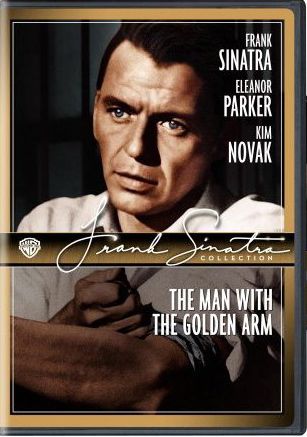
The Man with the Golden Arm (1955) - Star of the month... Frank Sinatra


'The Man with the Golden Arm' is a 1955 drama film directed by Otto Preminger and starring Frank Sinatra, Eleanor Parker, Kim Novak, Arnold Stang and Darren McGavin.

Based on the novel of the same name by Nelson Algren, the film tells of a heroin addict who becomes clean in prison, but then struggles with temptation after his release.

Former heroin addict Frankie Machine (played by Sinatra) is released from prison (where he has become clean) with a drum kit and a new lease on life. He returns to his wheelchair bound wife Zosh (played by Parker), and also runs into a former flame, Molly (played by Novak). Whilst out of jail, Frankie struggles to keep away from drugs, but later finds himself forced to deal in order to repay a debt.


Watch the trailer:


The title sequence

The film's controversial title sequence, designed by Saul Bass features the an animated paper cut out of a heroin addict's arms. The purpose of the cut out was to tap into the viewers emotions, and get them ready for the mood of the film.  Bass would later use a similar technique for Alfred Hitchcock films, 'Psycho' (1960), 'North by Northwest' (1959) and 'Vertigo' (1958).

Watch the title sequence:


Did you know...


  • The Motion Picture Association of America refused to certify the film because it was about a heroin addict - the film was released without the seal of approval
  • Marlon Brando was also considered for the role of Frankie Machine
  • In preparation for the film, Frank Sinatra spent time at drug rehabilitation centres to observe heroin addicts
  • According to Frank Sinatra Jr., the receiving hands of the second drug dealing belong to funny man Milton Berle


Award nominations


  • Academy Award nomination for Best Actor (Frank Sinatra)
  • Academy Award nomination for Best Art Direction/Set Decoration - Black & White
  • Academy Award nomination for Best Music Scoring of a Dramatic or Comedy Picture
  • BAFTA Award nomination for Best Film from any Source
  • BAFTA Award nomination for Best Foreign Actor (Frank Sinatra)
  • Satellite Award nomination for Outstanding Classic DVD (50th Anniversary Edition)


Closing remarks

'The Man with the Golden Gun' features one of Frank Sinatra's best dramatic roles. Otto Preminger broke ground by focusing on a taboo theme, such as heroin addiction, and persisting to release the film, even after it was refused classification. It helped shape censorship laws as a year later, films were permitted to depict drug use, kidnapping, prostitution and abortion.

Friday, 30 November 2012

All Fall Down (1962) - Star of the month Angela Lansbury


"I never know what I'm going to do next. I just follow the breeze. I just live for kicks." - Warren Beatty (as Berry-Berry Willart in 'All Fall Down')

'All Fall Down' is a 1962 drama directed by John Frankenheimer and starring Warren Beatty, Angela Lansbury, Karl Malden, Eva Marie Saint & Brandon deWilde.

Produced by John Houseman, the screenplay was written by William Inge, which was adapted from the novel by James Leo Herlihy.

Young drifter Berry-Berry Willart (played by Beatty) is a rebel with nowhere to go. He finds himself in and out of jail, and keeps away from his controlling mother, Annabel Willart (played by Lansbury) and father Ralph Willart (played by Karl Malden). His younger Clinton Willart (played by deWilde) idolises Berry-Berry, but soon discovers his nasty side when Echo (played by Saint), the daughter of a family friend stays with the Willarts.

Watch a short video about the film:

Family relationships

This film is all about family relationships.

The film's very first line informs the viewer the film is going to be about the relationship between two brothers, as Clinton says: "It seems that I've been on this crummy bus half my life, but I still think its worth it, because in a couple of minutes for the first time in over a year I'm going to see my brother Barry Barry".  At this point, Clinton idolizes and looks up to his older brother, Berry-Berry.

Also from the start of the film the viewer is informed of Berry-Berry's temper and wild behavior as we discover he is in jail. We are not informed of why he is in jail, which leads to suspense and curiosity as the we anxiously wait to find out. The waitress at the bar tells Clinton "if Berry-Berry was my brother, I wouldn't go around bragging about it", before escorting him to the door. Once we, along with Clinton finally meet Berry-Berry, Clinton tells him: "I don't want to go home. I want to stay with you".  Once we see what Clinton's home life is like with his parents, we can empathise with this statement.  Despite Clinton's strong admiration for his brother, the relationship between the two gradually deteriorates after Echo comes between the two.

Berry-Berry & Clinton's relationship with their mother is very different to most maternal relationships. They call their mother by her first name, Annabelle. Despite her controlling and to a degree manipulative ways, Annabelle does have good intentions. She loves her boys very much, and even makes Clinton pancakes for breakfast which he chooses to not eat. Instead opting to make his own breakfast.   At Christmastime, Annabelle is both surprised and grateful when Clinton gives her a gift. She asks him "For me?", as if she is doubting his generosity. In the film, Annabelle delivers one of my favourite statements: "Eavesdroppers never hear anything good about themselves." When you think about it, it's very true.

Clinton gives his mother Annabelle a Christmas gift - "For me?" she asks


Closing remarks

Overall, the film delivers a brilliant character study on family relationships, as well as tackling controversial issues such as female battery, adultery, and the female predator (cougar) prying on young men.  Despite taking 30 mins to introduce and develop the principle cast, the film is pure entertainment from the very beginning until the end. My favourite scene in the film occurs during Christmas time when Ralph invites 3 homeless tramps into their home, and Annabelle literally pays them $10 to leave.

Friday, 31 August 2012

The Man with the Golden Arm (1955) - Spotlight on... On the Edge!


'The Man with the Golden Arm' is a 1955 drama film directed by Otto Preminger and starring Frank Sinatra, Eleanor Parker, Kim Novak, Arnold Stang and Darren McGavin.


Based on the novel of the same name by Nelson Algren, the film tells of a heroin addict who becomes clean in prison, but then struggles with temptation after his release.

Former heroin addict Frankie Machine (played by Sinatra) is released from prison (where he has become clean) with a drum kit and a new lease on life. He returns to his wheelchair bound wife Zosh (played by Parker), and also runs into a former flame, Molly (played by Novak). Whilst out of jail, Frankie struggles to keep away from drugs, but later finds himself forced to deal in order to repay a debt.


Watch the trailer:


The title sequence

The film's controversial title sequence, designed by Saul Bass features the an animated paper cut out of a heroin addict's arms. The purpose of the cut out was to tap into the viewers emotions, and get them ready for the mood of the film.  Bass would later use a similar technique for Alfred Hitchcock films, 'Psycho' (1960), 'North by Northwest' (1959) and 'Vertigo' (1958).

Watch the title sequence:


Did you know...


  • The Motion Picture Association of America refused to certify the film because it was about a heroin addict - the film was released without the seal of approval
  • Marlon Brando was also considered for the role of Frankie Machine
  • In preparation for the film, Frank Sinatra spent time at drug rehabilitation centres to observe heroin addicts
  • According to Frank Sinatra Jr., the receiving hands of the second drug dealing belong to funny man Milton Berle


Award nominations


  • Academy Award nomination for Best Actor (Frank Sinatra)
  • Academy Award nomination for Best Art Direction/Set Decoration - Black & White
  • Academy Award nomination for Best Music Scoring of a Dramatic or Comedy Picture
  • BAFTA Award nomination for Best Film from any Source
  • BAFTA Award nomination for Best Foreign Actor (Frank Sinatra)
  • Satellite Award nomination for Outstanding Classic DVD (50th Anniversary Edition)


Closing remarks

'The Man with the Golden Gun' features one of Frank Sinatra's best dramatic roles. Otto Preminger broke ground by focusing on a taboo theme, such as heroin addiction, and persisting to release the film, even after it was refused classification. It helped shape censorship laws as a year later, films were permitted to depict drug use, kidnapping, prostitution and abortion.

Tuesday, 31 July 2012

Blow Up (1966) - Spotlight on... Trailblazers


**Warning: The contents of this blog post may offend some readers**

"I'm only doing my job. Some people are bullfighters, some people are politicians. I'm a photographer." - David Hemmings (as Thomas in 'Blow-Up')


'Blow-Up' is a 1966 mystery/thriller directed by Michelangelo Antonioni and starring David Hemmings, Vanessa Redgrave, Sarah Miles, John Castle, Jane Birkin, Tsai Chin, Gillian Hills and 60s fashion model Veruschka.  The film's screenplay was written by Antonioni and Tonino Guerra, with English dialogue by British playwright Edward Bond. The story is based on a short story by Julio Cortazar called 'Las babas del diablo' (or 'The Devil's Drool'). Produced by Carlo Ponti, this was the first of three English-language films Antonioni was to make for MGM.

Thomas takes photos of Veruschka
in one of my favourite images

Fashion photographer Thomas (played by Hemmings) believes he has unintentionally taken photographs of a murder, whilst taking photos at a nearby park. Thomas is almost driven to insanity with his obsession and quest to uncover the truth.

Voyeurism

A key theme in the film is voyeurism with Thomas willingly photographing anything he likes. That said, voyeurism it is not just seen through the lens of a camera. When Thomas walks into his friend's house and hears them in bed together, he doesn't leave as the average person would. He continues to walk through the house, into the hallway and watches their love making from the bedroom door. He watches them for over a minute before he decides to leave.

American release controversy

The American release of 'Blow-Up' was a significant milestone with it's explicit nudity and sexual innuendo. The strict Hollywood Production Code had initially refused to approve it. To bypass this, MGM created a new distribution company called 'Premiere Productions', which did not have an agreement to comply with the Production Code. The box office success and critical acclaim of the film led to the eventual destruction of the Production Code in 1968, and was replaced by the current classification system.


Watch the iconic controversial photography scene


Watch a controversial clip from 'Blow-Up'


Did you know...

  • This was Italian film director Michelangelo Antonioni's first English language film
  • The character of Thomas was inspired by real-life swinging London photographer David Bailey
  • One of the first British films to show full-frontal female nudity
  • Antonioni did not like the colour of the grass in the park, and it painted green
  • Terence Stamp was originally cast as Thomas, but was dropped 2 weeks before filming began
  • Swedish actress Evabritt Strangberg was originally considered for the role of Jane 

Closing remarks

I would consider 'Blow-Up' to be one of the first arthouse films I ever saw. I first watched it when I was in 18 in my first semester of studying film at university. Words cannot express my experience of watching 'Blow-Up' for the first time. While the majority of students in my tutorial found the film to be very boring and slow, I enjoyed it very much.  

There are three reasons why I love 'Blow Up'
  • They say a picture says a thousand words - With very minimal dialogue throughout the film, I like the way in which Antonioni uses image as a storytelling medium
  • I like how the music soundtrack is diegetic - This means it is heard only when someone turns on the radio or puts on a record
  • The third factor I like is how the film cuts off and does not give the spectator closure on how the story ends -  We, as the spectator are left to consider our own perception of what happens to Thomas, and the corpse


With it's psychedelic music soundtrack by Herbie Hancock, and borderline-anorexic models with vacant facial expressions, 'Blow-Up' is the ultimate mod movie from the 1960s.

Sunday, 29 July 2012

Sex Lies & Videotape (1989) - Spotlight on... Trailblazers


"Are you having an affair?" - Andie MacDowell (as Ann in 'Sex, Lies and Videotape')


Laura San Giacomo as Cynthia is having an
affair with her sister's husband
'Sex, Lies and Videotape' (1989) is a controversial independent film directed by Steven Soderbergh, and starring Andie MacDowell, James Spader, Peter Gallagher and Laura San Giacomo.


Sex, Lies and Videotape' was a very significant film at the time of it's release and highly influential in the progression of the independent film movement during the 1990s.


In 2006, the film was added to the Library of Congresses National Film Registry for being "culturally, historically or aesthetically significant".


David Spader as Graham watches
his videotapes
The film begins with Ann (played by MacDowell) confiding to her therapist about her unhappy marriage to husband John (played by Gallagher).  Ann is also annoyed John has agreed to let his college friend Graham Dalton (played by Spader) stay with them, without consulting with her first. Ironically after Graham arrives, Ann builds a strong rapport with him and the two develop a connection. That is until Ann discovers Graham's secret hobby of videotape interviewing women about their sexual experiences and fantasies.  Meanwhile, unbeknownst to Ann, her husband John is having an affair with her sister, Cynthia (played by San Giacomo).


Ann's video

I like the way in which we do not see the content of Ann's video as it is being filmed. After Ann says her name the scene cuts to when Ann returns home. It isn't until later when John visits Graham, that we see the content of Ann's videotape.  Through Soderbergh's technique, we (the film spectator) experience the video at the same time as John does, which empowers us to empathise with the feelings of shock and emotion.


Watch some memorable clips from the film:

Clip - "Ain't You A Picture"


Clip - "Finding the videotapes"


Clip - "Cynthia's Interview"


Clip - "Sex with Cynthia"


Clip - "Disarming her suspicions"


Closing remarks

'Sex, Lies and Videotape' caused a stir of controversy at the time of it's release. The film was instrumental in launching Soderbergh's career as a film director, and also made a star of Andie MacDowell.  Despite the perversion of the storyline, 'Sex, Lies and Videotape' is a very well made independent film and is enjoyable to watch.

Friday, 27 July 2012

Everything You Always Wanted to Know About... - Spotlight on... Trailblazers


***Note, some readers may find the content of this blog offensive**


"You hear these strange stories, you know, like there's a pill these women take, or sometimes guys will slam their head against a wall of hard rubber." - Woody Allen (as Sperm in 'Everything You Always Wanted to Know About Sex* (*But Were Afraid to Ask)')


'Everything You Always Wanted to Know About Sex* (*But Were Afraid to Ask)' is a 1972 comedy directed by Woody Allen. Based on the book of the same name by Dr. David Reuben, the film is an anthology of short episodes featuring cameo appearances by some of the biggest stars of the day including Tony Randall, Lynn Redgrave, Louise Lasser, Burt Reynolds and of course, Woody Allen (who appears in no less than 4 different roles). 


I have structured my blog into short episodes to mirror the structure of the film:

Main titles - 'Let's misbehave'

Woody Allen is a big fan of jazz, so it's no surprise he chose to open this film with a recording of Cole Porter's 'Let's Misbehave'.  I find Allen's interpretation of the song rather amusing, as we see thousands of breeding rabbits.


Watch the opening sequence - 'Let's Misbehave'


Woody Allen as The Fool in
'Do aphrodisiacs work?'
#1 - Do aphrodisiacs work?
Woody Allen plays The Fool to the King. The Fool finds out if aphrodisiacs work after he gives the Queen (played by Lynn Redgrave) a love potion. One problem... the Queen is wearing a chastity belt, complete with a padlock. While trying to remove the Queen's chastity belt, the Fool gets his hand caught, with fatal consequences.


#2 - What is sodomy?
Gene Wilder as Dr. Ross
The most disturbing (and possibly most unforgettable) of the seven episodes.  Dr. Ross (played by Gene Wilder) falls in love with one of his patients, Daisy... only thing is Daisy happens to be a sheep.


Dr. Ross wines and dines Daisy behind his wife's back at a fancy hotel, ordering "a chilled white burgandy, some cavier and some plain green grass" from room service. His fetish for sheep-loving eventually destroys his medical career, his marriage and every other aspect of his life. 


Here is a memorable clip from the 'What is sodomy?' segment


#3 - Why do some women have trouble reaching an orgasm?

Woody Allen & Louise Lasser as Fabrizio & Gina
A homage to the perversions of Italian cinema, this segment is spoken entirely in Italian (with English subtitles). Fabrizio (played by Woody Allen) is having trouble pleasing his wife Gina (played by Louise Lasser). After some experimentation he discovers Gina is only able to reach an orgasm in public. 


This segment drags on a little, but does have some very funny moments. 


#4 - Are transvestites homosexuals?

Sam Musgrave (played by Lou Jacobi) is a middle aged man who visits his daughter's fiancees parents. While visiting Sam feels the need to experiments with women's clothes. This is one of the funniest sketches in the film.


#5 - What are sex perverts?

Game show spoof of 'What's my Line?', called 'What's my Perversion?'. Filmed in black and white, four contestants must accurately guess the perversion of the panelist, in this instance, "likes to expose himself on subways". There is even a mock TV commercial for a hair product.
This is the most offensive of each of the chapters, ending with an image of a rabbi eating pork.


#6 - Are the findings of doctors and clinics who do sexual research and experiments accurate?

Sex researcher Victor (played by Allan) and reporter Helen (played by Heather MacRae) visit the evil and psychotic Dr. Bernardo (played by John Carradine), who is conducting sexual experiments on abducted humans. One of his experiments goes horribly wrong, generating a "gigantic tit", which terrorises the local town, crushing the innocent and spitting milk. This spoof of the scifi b-movies of the 1950s in my opinion is the slowest and least enjoyable segment within the film.


#7 - What happens during ejaculation?

Woody Allen as Sperm
Amusing segment positioning a man's brain as a NASA-like mission control centre operated by Tony Randall and Burt Reynolds. Woody Allen makes his fourth appearance in the film as a nervous and scared Sperm. 


A memorable and rather appropriate conclusion to the film.


Deleted segment - What makes a man a homosexual?

A photograph from the deleted sequence -
The Black Widow (Lasser) prepares to eat
the Common Spider (Allen)
An eighth segment filmed but cut from the film was called "What Makes a Man a Homosexual?" and featured Woody Allen as a common spider, with Louise Lasser playing a black widow. After making love, the black widow ate the common spider. The segment was not included in the final film as Allen was unable to write an appropriate ending. 


Controversy

Very funny and highly inappropriate, 'Everything You Always Wanted to Know About Sex...' was a very controversial film at the time of it's release. Although not visually graphic or explicit, the clever innuendo and provocative subject matter caused a stir.


Closing remarks

This film welcomed the world to the perverted yet intelligent mind of Woody Allen. After watching this film, it would come as no surprise to anyone when Allen later married his stepdaughter. Although not Allen's best film, 'Everything You Always Wanted to Know About Sex...' makes for an entertaining and amusing spectator experience.

Monday, 23 July 2012

Freaks (1932) - Spotlight on... Trailblazers


Some of the "freaks" from the film
'Freaks' is a 1932 pre-code horror film directed and produced by Tod Browning. It is loosely based on Tod Robbins' 1923 short story 'Spurs', about a midget who falls in love with a full grown woman.


'Freaks' is a very unusual and unique cinema experience. Rather than using costume, make up and other special effects, Browning cast real people with deformities to play the "circus freaks.


Stirring controversy on its initial release, it sadly destroyed the brilliant directing career of Browning overnight. Fortunately in recent years the film has received the praise and acclaim it deserves.


Watch a trailer for this film:


The Siamese twins
'Freaks' is the love story of two dwarfed circus performers, Hans (played by Harry Earles) and Frieda (played by Daisy Earles)... well almost. Frida is in love with Hans, but Hans is in love with the "normal" Cleopatra (played by Olga Baclanova). Cleopatra is not genuinely in Hans, however conspires with her lover Hercules to marry and murder Hans in order to collect his inheritance.


In ancient times, deformity was considered to be evil, with families bearing deformed children believing they were cursed. This belief is a result of conditioning of their ancestors. Browning challenges this belief and presents a new paradigm. In this film it is the deformd "Freaks" who are the heroes of the film, with two "normal" members of the circus, who are the villains. Browning has also empowered Hans to be more intelligent than he looks. This is evident in the scene where Hans spits out the "medicine" (really poison) Cleopatra gives him.


Controversy

Hans & Frida
The release of 'Freaks' was a very controversial event which shocked and horrified movie goers. One woman even threatened to sue MGM, claiming the film had caused her a miscarriage. Due to the overwhelmingly negative reaction, the film was edited down from 90 minutes to 64 minutes.
The film was even banned in the UK for 30 years. Despite this controversy, in 1994, 'Freaks' was selected for preservation by the United States National Film Registry as being "culturally, historically, or aesthetically significant". It is also considered to be a cult classic, with regular midnight movie screenings since the 1970s.


Did you know...


  • Myrna Loy was initially intended to star as Cleopatra, with Jean Harlow as Venus, however MGM decided to not cast any of their major stars in this controversial film


Closing remarks

The human torso lights his cigarette using his mouth
Despite it being a truly bizarre and confronting experience, I like this film a lot, and have seen it several times.  Without giving too much away, I really like the way in which the deformed "freaks" use their disadvantages to their advantages by hiding in narrow nooks and crannies to protect a beloved friend and save the day. Another highlight for me is seeing the Human Torso (played by Prince Randian) light a match and cigarrette using only his mouth. A truly inspirational moment!

Sunday, 22 July 2012

The China Syndrome - Spotlight on...Trailblazers


"It's my story! It's my exclusive! I want to do it!"  - Jane Fonda (as Kimberly Welles in 'The China Syndrome')


'The China Syndrome' is the 1979 drama/thriller directed by James Bridges and starring Jane Fonda, Michael Douglas and Jack Lemmon.


Jane Fonda as TV news reporter Kimberly Welles &
Michael Douglas as photographer Richard Adams
The title refers to the China Syndrome, which describes a worst-case scenario in a nuclear meltdown, where components melt their containment structures, through the floor of the plant, and into the earth travelling all the way to China.


Jane Fonda stars as Kimberly Welles, a determined and driven TV reporter who is visiting a nuclear power plant in California with her cameraman Richard Adams (played by Douglas). During their visit, they witness an emergency shutdown, due to an incident, which the power plant attempts to cover up. Richard secretly films the shutdown, despite being asked not to, and shows it to an expert who claims the power plant were close reaching the China Syndrome. The rest of the film involves the plants attempt to cover up the event, with Kimberly and Richard determined to uncover the truth with the help of shift supervisor Jack Godell (played by Lemmon).


Watch the trailer:


Release controversy

The release of 'The China Syndrome' sparked some controversy when a real life nuclear accident occurred 12 days after its release at Three Mile Island in Dauphin County, Pennsylvania. What's even more ironic is in the film, physicist Dr. Elliott Lowell (played by Donald Hotton) says the China Syndrome would make "an area the size of Pennsylvania" permanently uninhabitable.


Absence of a music soundtrack

Something I really like about this film is there is no traditional music soundtrack which the audience hears, and the characters do not.  Although there is some music heard at different points, the music originates from sources within the film, which the characters can hear, such as music playing on car radios, bar jukeboxes, TV commercials, etc.  Even the end credits roll in complete silence.


Did you know...

  • Michael Douglas also produced this film
  • Richard Dreyfuss was originally meant to play Richard Adams

Awards nominations...


  • Academy Award nomination for Best Actor (Jack Lemmon)
  • Academy Award nomination for Best Actress (Jane Fonda)
  • Academy Award nomination for Best Art Direction-Set Decoration
  • Academy Award nomination for Best Writing; Original Screenplay
  • Cannes Film Festival Palme d'Or (Golden Palm) nomination
  • Cannes Film Festival winner Best Actor (Jack Lemmon)


Closing remarks

'The China Syndrome' is a wonderful film. I find it distorts your perception around big business corruption and makes you wonder how many incidents like this may really occur, and are kept quiet and covered up by those with money and power.  Heart pounding suspense and superb performances by Fonda, Douglas and Lemmon make 'The China Syndrome' compelling and engaging viewing.

Thursday, 12 July 2012

The Seven Year Itch (1955) - Spotlight on... Trailblazers


Spotlight on... Trailblazers


"When it's hot like this, do you know what I do? I keep my undies in the inbox." - Marilyn Monroe (as The Girl)

The Seven Year Itch is a 1955 comedy directed by Billy Wilder and starring Marilyn Monroe and Tom Ewell. The supporting cast includes Evelyn Keys and Carolyn Jones.

This film is contains one of the most iconic images of the 20th century... the infamous scene of Marilyn's white dress blowing up by the air from the subway grating.

The amusing sex farce depicts the troubles of a middle aged married man and is based on the successful Broadway play of the same name by George Axelrod.

Marilyn stars as The Girl (with no name)
Richard Sherman (played by Ewell) sends his wife Helen (played by Keyes) and son away to Maine for the Summer. Meanwhile The Girl (the character has no official name - played by Marilyn) rents the apartment directly above Richard.  Consequently Richard gives a new meaning to the saying when the wife's away, the man will play, by overtly flirting with The Girl and engaging in a number of sexual fantasies.

The cast

Tom Ewell is perfectly cast in the film, reprising his stage role of Sherman.
Marilyn tickles, sizzles and tantalises with her sexy yet innocent portrayal as the girl upstairs.

Carolyn Jones (best known for playing Morticia Addams in the 1960's version of The Addams Family) has an amusing cameo as an oversexed nurse, Miss Finch, in one of Richard's dreams.

Controversy

Although innocent and tame by today's standards, 'The Seven Year Itch' pushed the limits while it is being filmed and was extremely controversial, with Hollywood censors closely watching the filming.

The film shocked audiences with its explicit footage of marital infidelity, breaching the Hays Production Code stating adultery must never be used for comedy or ridicule. In the stage play, Richard has an affair with The Girl, whereas in the film, only a fantasy is implied.

The Catholic Legion of Decency also condemned the film and discoraged Catholics from attending the film.

Marilyn's skirt blowing scene

Despite the film's poster and iconic image, this is as high
as the dress blows up in the final film
The infamous skirt blowing scene was filmed on Lexington Avenue at 52nd Street in New York City. A large crowd watched the filming, including Marilyn's infuriated husband Joe DiMaggio, who separated from Marilyn shortly after. Marilyn wore two pairs of undies to ensure her modesty was protected.


Did you know...

  • Walter Matthau screen tested for the role of Richard Sherman
  • Tom Ewell never watched any of his films, including this one, as he did not a fan of film as an art form, and preferred acting on the stage
  • This was one of Evelyn Keyes' final major film roles
  • The exterior location of Richard's apartment is 164 East 61st St, Manhattan


Awards and nominations

  • Golden Globe Award winner - Best Actor in a Musical or Comedy (Tom Ewell)
  • Directors Guide of America Award nomination (Billy Wilder)


Closing remarks

'The Seven Year Itch' is truly a fun film to watch over and over again. Marilyn superbly plays the blonde bimbo, and immortalised herself with the famous skirt blowing scene. In my opinion this is Marilyn's funniest film (even funnier than 'Some Like It Hot').  I recommend 'The Seven Year Itch' to anyone who enjoys a good laugh.