Showing posts with label turner classic movies. Show all posts

Tuesday, 4 December 2012

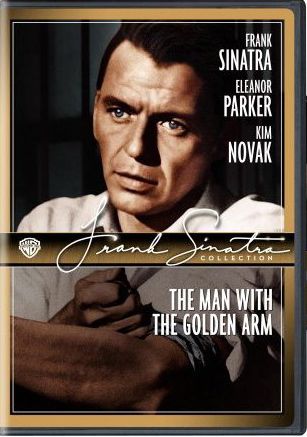
The Man with the Golden Arm (1955) - Star of the month... Frank Sinatra


'The Man with the Golden Arm' is a 1955 drama film directed by Otto Preminger and starring Frank Sinatra, Eleanor Parker, Kim Novak, Arnold Stang and Darren McGavin.

Based on the novel of the same name by Nelson Algren, the film tells of a heroin addict who becomes clean in prison, but then struggles with temptation after his release.

Former heroin addict Frankie Machine (played by Sinatra) is released from prison (where he has become clean) with a drum kit and a new lease on life. He returns to his wheelchair bound wife Zosh (played by Parker), and also runs into a former flame, Molly (played by Novak). Whilst out of jail, Frankie struggles to keep away from drugs, but later finds himself forced to deal in order to repay a debt.


Watch the trailer:


The title sequence

The film's controversial title sequence, designed by Saul Bass features the an animated paper cut out of a heroin addict's arms. The purpose of the cut out was to tap into the viewers emotions, and get them ready for the mood of the film.  Bass would later use a similar technique for Alfred Hitchcock films, 'Psycho' (1960), 'North by Northwest' (1959) and 'Vertigo' (1958).

Watch the title sequence:


Did you know...


  • The Motion Picture Association of America refused to certify the film because it was about a heroin addict - the film was released without the seal of approval
  • Marlon Brando was also considered for the role of Frankie Machine
  • In preparation for the film, Frank Sinatra spent time at drug rehabilitation centres to observe heroin addicts
  • According to Frank Sinatra Jr., the receiving hands of the second drug dealing belong to funny man Milton Berle


Award nominations


  • Academy Award nomination for Best Actor (Frank Sinatra)
  • Academy Award nomination for Best Art Direction/Set Decoration - Black & White
  • Academy Award nomination for Best Music Scoring of a Dramatic or Comedy Picture
  • BAFTA Award nomination for Best Film from any Source
  • BAFTA Award nomination for Best Foreign Actor (Frank Sinatra)
  • Satellite Award nomination for Outstanding Classic DVD (50th Anniversary Edition)


Closing remarks

'The Man with the Golden Gun' features one of Frank Sinatra's best dramatic roles. Otto Preminger broke ground by focusing on a taboo theme, such as heroin addiction, and persisting to release the film, even after it was refused classification. It helped shape censorship laws as a year later, films were permitted to depict drug use, kidnapping, prostitution and abortion.

Sunday, 2 December 2012

On the Town (1948) - Star of the month... Frank Sinatra


"East side, West side, rouse the city... One day, one night, that's the pity...Let's have a ball tonight, we're going on the town"

Frank Sinatra, Betty Garrett, Jules Munshin, Ann Miller,
Gene Kelly & Vera-Ellen in 'On the Town'
'On the Town' is a 1949 musical directed by Gene Kelly & Stanley Donen, and starring Gene Kelly, Frank Sinatra, Betty Garrett, Ann Miller, Vera-Ellen, Jules Munshin & Alice Pearce.

The film features a screenplay by Adolph Green and Betty Comden, from their Broadway musical of the same name.

Three sailors with twenty four leave are set to paint the town red, white and blue as they embark on a one day trip to New York, New York. They see this month's Miss Turnstile, Ivy Smith. They embark on a three man mission to find her. On the way, they meet and get some help from female taxi-driver Hildy (played by Garrett) and anthropological student Claire Huddesen (played by Miller).
"New York, New York, it's a wonderful town!"

Trailer

The trailer was produced as a mock James A. Fitzpatrick "TravelTalk: The Voice of the Globe" short film on Manhattan, with narration by Fitzpatrick. 
Watch the trailer:


Musical program

Frank Sinatra & Betty Garrett sing
"Come Up To My Place"
  • "New York, New York" - Gene Kelly, Frank Sinatra & Jules Munshin
  • "Miss Turnstiles Dance" - Vera-Ellen
  • "Prehistoric Man" - Ann Miller (with Gene Kelly, Frank Sinatra, Betty Garrett & Jules Munshin)
  • "Come Up To My Place" - Frank Sinatra & Betty Garrett
  • "Main Street" - Gene Kelly (with Vera-Ellen)
  • "You're Awful" - Frank Sinatra (with Betty Garrett)
  • "On The Town" - Gene Kelly, Frank Sinatra, Betty Garrett, Ann Miller, Vera-Ellen & Jules Munshin
  • "Sambacabana Revue" - Sambacabana Chorus Girls
  • "Dixieland Revue" - Dixieland Chorus Girls
  • "Shanghai Revue" - Shanghai Chorus Girls
  • "Count On Me" - Gene Kelly, Frank Sinatra, Betty Garrett, Ann Miller, Jules Munshin & Alice Pearce
  • "A Day in New York: A Ballet in 3 Acts" - Gene Kelly & Vera-Ellen
  • "New York, New York" (Finale)

The only musical numbers retained from the original musical were "New York, New York", "Miss Turnstiles Dance", "Come Up To My Place" and the "A Day in New York Ballet".  Six new songs written for the film replaced the following songs not included: "I Can Cook Too", "Some Other Time", "Lucky To Be Me", "Lonely Town", "Carried Away", "I Understand", "Carnegie Hall (Do-Do-Re-Do)", "So Long Baby", "I'm Blue" and "Ya Got Me".


Song: "New York, New York" - Gene Kelly, Frank Sinatra & Jules Munshin


Song: "Come Up To My Place" - Betty Garrett & Frank Sinatra


Song: "On The Town" - Gene Kelly, Frank Sinatra, Ann Miller, Betty Garrett, Jules Munshin & Vera-Ellen


Song: "Prehistoric Man" - Ann Miller (with Gene Kelly, Frank Sinatra, Betty Garrett & Jules Munshin)


Song: "You Can Count On Me" - Gene Kelly, Frank Sinatra, Ann Miller, Betty Garrett, Jules Munshin & Alice Pearce


Clip from "A Day in New York Ballet" - Gene Kelly & Vera-Ellen


Song: "Miss Turnstile's Dance" - Vera-Ellen


Did you know...


  • This was the first major musical to be filmed on location
  • This was the third and final film Gene Kelly and Frank Sinatra made together
  • This was the screen debut for Alice Pearce, Carol Haney and Bea Benaderet
  • Alice Pearce originally played Lucy Schmeeler in the original Broadway production of 'On the Town' - she was the only member of the Broadway cast to appear in the film
  • At the time of it's release, 'On the Town' was the second highest grossing film in MGM history, after 'Meet Me in St. Louis' (1944)
  • Judy Holliday dubbed the following line of dialogue for an uncredited bit player: "The grass is always greener, if ya know what I mean"
  • The Club Dixieland Chorus girls are wearing costumes previously worn in 'The Harvey Girls' (1946)
  • Gene Kelly once said this was his favourite of all his films

Closing remarks


Whenever I think about my favourite movie musicals, one of the first films I always think of is 'On The Town'. I absolutely adore it! 

'On the Town' is 100% pure entertainment from the moment the three boys step off the boat and sing "New York, New York", until they return to the ship 24 hours later. 

The story is engaging, the jokes funny, the songs show-stopping and the performances brilliant. 

Speaking of the performances, I'd like to make special mention of four of the actresses in this film...
Ann Miller in 'Prehistoric Man', backed up by the world's
most expensive chorus: Gene Kelly, Frank Sinatra,
Betty Garrett & Jules Munshin

Ann Miller... What can I say? LOVE HER!!! This was the first Ann Miller film I had ever seen, and she instantly became one of my top 3 favourite stars, and she still is. Ann Miller once remarked, she had the world's most-expensive chorus backing her up in the 'Prehistoric Man' number... the chorus being Gene Kelly, Frank Sinatra, Betty Garrett & Jules Munshin.

Betty Garrett is fantastic as taxi-driver Hildy. Garrett is an actress I like very much, but sadly did not appear in many films.

Vera-Ellen is perfect as Ivy Smith, and it's pleasing to see her reunited with Gene Kelly. The two had initially danced together in the 1948 musical biography 'Words and Music'.

Alice Pearce, remembered by most people as the first Mrs. Kravitz in the 1960s TV series 'Bewitched'. Despite having a very small role in 'On the Town', Pearce shows us her unique comedic talent at being the annoying ugly duckling.

I repeat, 'On the Town' is one of the best movie musicals ever made, with Gene Kelly, Frank Sinatra, Betty Garrett and Ann Miller at their best. I love 'On the Town', and I know you will too!

Take Me Out to the Ball Game (1949) - Star of the month... Frank Sinatraarthur freed, betty garrett, busby berkeley, edward arnold, esther williams, frank sinatra, gene kelly, jules munshin, mgm, MGM musical, take me out to the ballgame, TCM, turner classic movies,


"It's fate, baby, it's fate, and it's knocking at our door... It's fate, baby, and that's the reason, you're mine and I am yours." - Betty Garrett (as Shirley Delwyn in 'Take Me Out to the Ballgame')


Frank Sinatra & Gene Kelly sing the title song
'Take Me Out to the Ballgame' is a 1949 musical directed by Busby Berkeley and starring Frank Sinatra, Esther Williams and Gene Kelly with Betty Garrett, Jules Munshin, Edward Arnold and Richard Lane.

Produced by Arthur Freed

Set in 1908, the film tells the story of fictional American League baseball team, the Wolves, and two of its players (who are also vaudevillians), Eddie O'Brien (played by Kelly) and Dennis Ryan (played by Sinatra). 

Frank Sinatra serenades Esther Williams
The ballplayers are devastated when the find out, the new owner of the Wolves is a woman, K.C. Higgins (played by Williams). Shorly after both Eddie and Dennis find themselves both falling in love with her. Things get complicated for Dennis when Shirley Delwyn falls in love with him.


Musical program

Frank Sinatra, Jules Munshin & Gene Kelly sing
"O'Brien to Ryan to Goldberg"
Musical program features:
  • "Take Me Out to the Ball Game" - Frank Sinatra & Gene Kelly
  • "Yes, Indeedy" - Frank Sinatra & Gene Kelly (with Jules Munshin)
  • "O'Brien to Ryan to Goldberg" - Frank Sinatra, Gene Kelly & Jules Munshin
  • "Take Me Out to the Ball Game" (Reprise) - Esther Williams
  • "The Right Girl For Me" - Frank Sinatra
  • "The Right Girl For Me" (Reprise) - Gene Kelly
  • "It's Fate, Baby, It's Fate" - Betty Garrett & Frank Sinatra
  • "Strictly U.S.A." - Frank Sinatra, Gene Kelly, Esther Williams, Betty Garrett & Jules Munshin
  • "The Hat My Father Wore On St. Patrick's Day" - Gene Kelly
  • "Finale: Strictly U.S.A." - Frank Sinatra, Gene Kelly, Esther Williams & Betty Garrett

Watch some of the musical highlights below...

Song: "Take Me Out to the Ball Game" - Frank Sinatra & Gene Kelly


Song: "It's Fate, Baby, It's Fate" - Betty Garrett & Frank Sinatra


Song: "O'Brien to Ryan to Goldberg" - Frank Sinatra, Gene Kelly & Jules Munshin


"Strictly USA" - Frank Sinatra, Gene Kelly, Esther Williams & Betty Garrett 


Song: "The Hat My Father Wore Upon St. Patrick's Day" - Gene Kelly


Song: "The Right Girl For Me" - Frank Sinatra


Song: "Yes, Indeedy" - Frank Sinatra & Gene Kelly (with Jules Munshin)


Deleted musical sequences

Two songs were filmed but deleted from the final film:

'Boys and Girls Like You And Me'
- Originally written for the Broadway musical "Oklahoma" (1943), it was cut from the final show; it was then supposed to appear in the film 'Meet Me In St. Louis' (1943), but was also cut from that as well; 
- Danny was supposed to sing the song to Shirley, the song was filmed however it was deemed too slow for the film and was cut
- The melody from the song was later featured in the TV movie musical 'Cinderella' (1957), with the song finally being sung in the 1996 stage production of 'State Fair'


'Babydoll'
- 'Babydoll' was developed after Gene Kelly prevented an Esther Williams swimming number from being included in the film
- Intended to be a lighthearted song and dance interlude for Gene Kelly and Esther Williams, the song was cut as it was considered to be "out of step" wit the rest of the film
- The song was later used in the film 'The Belle of New York' (1952), and performed by Fred Astaire and Vera-Ellen
- Although most of the footage filmed for the song exists, a small component of  footage is missing

Did you know...

  • This was the second of three "buddy films" Frank Sinatra and Gene Kelly made together
  • Gene Kelly, Frank Sinatra, Jules Munshin and Betty Garrett would all be reunited a year later in "On The Town" (1949)
  • The idea for the film was conceived by Gene Kelly, who wanted to pay tribute to the early years of baseball
  • Judy Garland was the original choice to play K.C. Higgins, however she had become unreliable due to her addiction to antidepressants
  • June Allyson was considered for the role of K.C. Higgins, but fell pregnant
  • Kathryn Grayson was considered for the role of K.C. Higgins
  • In Britain, the film was released under the title 'Everybody's Cheering', as baseball is not popular there
  • The final directed by solely by Busby Berkeley
  • Baseball player Leo Durocher was originally intended to play the role of Danny Ryan
  • In her autobiography, Esther Williams described her time on the film as "pure misery", and claimed Gene Kelly & Stanley Donen treated her with contempt, and made nasty jokes about her - Williams believes this was because Kelly was uncomfortable with her being 3 inches taller than him


Award nominations

  • Writers Guide of America Award nomination for Best Written American Musical 


Esther Williams appears briefly in a swimming pool

Closing remarks

In my opinion 'Take Me Out to the Ballgame' is a below average MGM musical.  The pace of film gets slow from time to time, and there are not nearly enough songs. This aside, the stars are fantastic and the film was very successful upon it's release.

In addition to Gene Kelly and Frank Sinatra, I am also a big fan of the two actresses in the film: Esther Williams and Betty Garrett.
  • Esther Williams was one of MGMs biggest money makers, and sadly she does not perform an underwater ballet sequence in this film. We do get to see her briefly in the swimming pool.
  • Esther Williams, Gene Kelly, Frank Sinatra & Betty Garrett
    perform the finale of "Strictly U.S.A."
  • Betty Garrett's role in the film is also far too short, as it takes 40 minutes for her character to be introduced. Betty Garrett was a wasted talent and sadly didn't make nearly enough films.
Overall not a bad film, although in my opinion it's inferior to the other two Kelly/Sinatra films "Anchors Aweigh" (1945) and "On the Town" (1949).

Sunday, 23 September 2012

Flesh and the Devil (1926) - Star of the month... Greta Garbo


"You know... when you blow out the match... that's an invitation to kiss you" - Greta Garbo (as Felicitas von Rhaden in 'Flesh and the Devil')

'Flesh and the Devil' (1926) is a silent romance-drama produced by MGM, directed by Clarence Brown and starring Greta Garbo, John Gilbert, Lars Hanson and Barbara Kent. 

The film is based on the play 'The Undying Past' by Hermann Sudermann.

In 2006, 'Flesh and the Devil' was selected for preservation in the United States National Film Registry by the Library of Congress as being "culturally, historically or aesthetically significant."

Leo (played by Gilbert) falls in love with the beautiful Felicitas von Rhaden (played by Garbo). Felicitas does not tell Leo she is already married, and the pair are shortly caught in bed together by her husband, Count von Rhaden (played Marc McDermott). Infuriated the Count challenges Leo to a duel, and is killed by Leo. As punishment for killing the Count, Leo is sent to Africa for five years, and before leaving Leo asks his best friend Ulrich (played by Hanson) to care of Felicitas while he is away. As Leo returns from Africa, he finds Felicitas and Ulrich married, and Felicitas finds herself in love with both men.


Greta Garbo & John Gilbert fell in love off-screen when making this film

Garbo & Gilbert: A love story

'Flesh and the Devil' was the first film Greta Garbo & John Gilbert made together, and shortly after meeting the pair fell in love off-screen. Before the film was complete, the pair had already moved in together and shortly after the pair became engaged to be married. However, Greta Garbo never showed up to the wedding, and left poor John Gilbert waiting at the alter.

The church scene

One of my favourite sequences within 'Flesh and the Devil' is the scene in the church. I like this scene for a number of reasons:

Firstly, I think it was clever of Clarence Brown to position Felicitas and Ulrich on one side of the church, and position Leo on the other side. The aisle between them is a metaphor of the division separating Felicitas and Leo.

Secondly, the priest delivers a very passionate sermon on David seducing Uriah's wife, which is a result of the priests observations of Leo pursuing Felicitas.

Thirdly, while taking holy communion, the priest hands Felicitas the chalice to drink from it immediately after Leo. Felicitas twists the chalice and places her lips directly where Leo's lips had just moistened the chalice. This is metaphorical for her desire to kiss Leo inside the church.

Did you know...


  • The first of 8 Greta Garbo films directed by Clarence Brown
  • Lillian Gish was originally considered to play the role of Felicita, however at $1 million per film she was deemed to expensive - the role was then given to recent hire Garbo, who was payed $450 per week
  • The film was such a success for MGM and Great Garbo, that Garbo was considered 12% of the entire studios value by the end of 1927
  • Greta Garbo had initially refused to appear in the film due to her sister's recent death from cancer - MGM sent her a sternly worded telegram threatening deportation and Garbo soon agreed to appear in the film


Closing remarks

'Flesh and the Devil' is an enjoyable Greta Garbo silent film to watch. The image of Greta Garbo lighting her cigarette in her first scene is pure magic, and seeing the two Hollywood lovers (Garbo & Gilbert) falling in love with each other before my very eyes is just as magical, if not more.

What makes this film so brilliantly crafted is it's ability to communicate a story with images. If you were to edit out the title cards throughout the film and remove the music, it would still be possible to follow the story as the film is so well directed and acted.

Sunday, 9 September 2012

Anna Christie (1931-German Version) - Star of the month... Greta Garbo


'Anna Christie' is a 1931 German-language adaptation of the Pulitzer Prize winning Broadway play by Eugene O'Neill. 

It stars Greta Garbo, and was filmed following the release of an English language version from 1930, also starring Garbo. The sets and costumes were reused from the 1930 film.

The film is directed by Jacques Feyder and co-stars Theo Shall, Hans Junkermann and Salka Viertel.

Anna Christie (played by Garbo) returns home and is reunited with her sailor father Chris (played by Junkermann) who she has not seen in many years. Anna rescues and falls in love with another sailor, Matt Burke (played by Shall), but neglects to tell him about her past career as a prostitute.

Father-daughter relationship

In the film, we find out Chris was forced to give up Anna as a result of his being a sailor. Although Anna and Chris' relationship improves throughout the film, Anna has some hostility and resentment towards her father.


Did you know...

  • Greta Garbo preferred this German version of 'Anna Christie' over the American version she made in 1930

Closing remarks

Like Greta Garbo, I too find this German version of 'Anna Christie' to be better than the 1930 Hollywood production. Garbo's acting is more naturalistic, and co-stars Theo Shall and Hans Junkermann are better than Charles Bickford and George F. Marion from the 1930 version. The only which I found better in the original was Marie Dressler's performance as Marthy.

Friday, 31 August 2012

The Man with the Golden Arm (1955) - Spotlight on... On the Edge!


'The Man with the Golden Arm' is a 1955 drama film directed by Otto Preminger and starring Frank Sinatra, Eleanor Parker, Kim Novak, Arnold Stang and Darren McGavin.


Based on the novel of the same name by Nelson Algren, the film tells of a heroin addict who becomes clean in prison, but then struggles with temptation after his release.

Former heroin addict Frankie Machine (played by Sinatra) is released from prison (where he has become clean) with a drum kit and a new lease on life. He returns to his wheelchair bound wife Zosh (played by Parker), and also runs into a former flame, Molly (played by Novak). Whilst out of jail, Frankie struggles to keep away from drugs, but later finds himself forced to deal in order to repay a debt.


Watch the trailer:


The title sequence

The film's controversial title sequence, designed by Saul Bass features the an animated paper cut out of a heroin addict's arms. The purpose of the cut out was to tap into the viewers emotions, and get them ready for the mood of the film.  Bass would later use a similar technique for Alfred Hitchcock films, 'Psycho' (1960), 'North by Northwest' (1959) and 'Vertigo' (1958).

Watch the title sequence:


Did you know...


  • The Motion Picture Association of America refused to certify the film because it was about a heroin addict - the film was released without the seal of approval
  • Marlon Brando was also considered for the role of Frankie Machine
  • In preparation for the film, Frank Sinatra spent time at drug rehabilitation centres to observe heroin addicts
  • According to Frank Sinatra Jr., the receiving hands of the second drug dealing belong to funny man Milton Berle


Award nominations


  • Academy Award nomination for Best Actor (Frank Sinatra)
  • Academy Award nomination for Best Art Direction/Set Decoration - Black & White
  • Academy Award nomination for Best Music Scoring of a Dramatic or Comedy Picture
  • BAFTA Award nomination for Best Film from any Source
  • BAFTA Award nomination for Best Foreign Actor (Frank Sinatra)
  • Satellite Award nomination for Outstanding Classic DVD (50th Anniversary Edition)


Closing remarks

'The Man with the Golden Gun' features one of Frank Sinatra's best dramatic roles. Otto Preminger broke ground by focusing on a taboo theme, such as heroin addiction, and persisting to release the film, even after it was refused classification. It helped shape censorship laws as a year later, films were permitted to depict drug use, kidnapping, prostitution and abortion.

Tuesday, 21 August 2012

Let's Make Love (1960) - Star of the month... Gene Kelly


Let's Make Love is the 1960 romantic musical comedy starring Marilyn Monroe with French actor Yves Montand and funny man Tony Randall. The supporting cast includes British singer Frankie Vaughan and Wilfred Hyde-White. The film was directed by the legendary George Cukor and features surprise guest cameos by three Hollywood greats appearing as themselves: Gene Kelly, Milton Berle and Bing Crosby.

Yves Montand stars as Jean-Marc Clement, a billionaire who is advised he is about to be parodied in an off-Broadway revue. Jean-Marc visits the theatre to find out more about it, but is mistaken as an actor auditioning for the role. He is offered the role due to his uncanny resemblance and real life performance. He is bewildered by the show's star Amanda Dell (played by Monroe), and decides to play along with the charade. Jean-Marc hires Milton Berle to teach him to tell jokes, Bing Crosby to teach him to sing, and Gene Kelly to teach him to dance. Despite this first rate tuition, Amanda teaches Jean-Marc money can't buy you love.

Upon release the film was not a critical or commercial success, and was one of Marilyn's only films to lose money.


Musical highlights
Let's Make Love features quite a few unmemorable and unexciting musical numbers. There are fortunately two stand out numbers: "My Heart Belongs To Daddy" and "Specialisation".

Song: "My Heart Belongs To Daddy" - Marilyn Monroe


Did you know...
  • Marilyn was not satisfied with the script and had her then-husband Arthur Miller review and rewrite it.
  • The following actors all turned down the role of Jean Clement: Gregory Peck, Cary Grant, Charlton Heston, Yul Brynner and Rock Hudson
  • Montand and Monroe reportedly had an off-screen affair during the filming of this film


Concluding remarks

Despite its unrealistic plot and very predictable ending, overall the film is amusing to watch with quite a few laughs. The highlight for me was Milton Berle, who gets more laughs in his 8 minutes cameo than any of the other lead actors. Worth watching if you're a fan of Marilyn or Milton Berle.