'Joyless Street' (Die freudlose Gasse) is a 1925 German silent film directed by Georg Wilhelm Pabst and starring Greta Garbo (in her second major film role) with Werner Krauss and Asta Nielsen. Based on the novel by Hugo Bettauer, and set in post-war Vienna, the film presents a study on the clear division between the hungry and the privileged. Greta Rumfort (played by Garbo) has just lost her job, is struggling to feed her father and younger sister. Matters are made worse when her father invests all of his savings into the stock market, which plunges after a false rumour about a strike. After renting a room in their flat to an American official, the money is taken by one of her father's creditors. Greta's neighbour in an attempt to assist, offers Greta a job in their cabaret/brothel.
Greta Garbo in a publicity still for this film
Did you know...
This was Greta Garbo's second starring role
In the US, the film was released under the title, "The Street of Sorrow"
In Canada, the film was released under the title, "Viennese Love"
The dark haired woman waiting in line at the butcher is not Marlene Dietrich (as many people often think) - it is actually Hertha von Walther
In 1997, the film was remastered by the Filmmuseum Munich, where it was given a new musical score
Closing remarks
I was expecting this silent film to be slow and boring, but surprisingly, it was very entertaining and engaging. Just from this early screen appearance, Garbo radiates a glow and it is quite obvious she is destined to become a big star.
"I want to be left alone..." - Greta Garbo Throughout September 2012, we pay tribute to one of the most beautiful women in the world... Greta Garbo... Greta Garbo was born Greta Lovisa Gustafsson on 18 September 1905 in Stockholm, Sweden. She was forced to leave school and work following her father's death when she was 14 years old. She found work in a department store, who used her as a model in newspaper advertisements. She also appeared in a short film advertising the department store she worked at. This led her to appear in some other films in Sweden. At age 19, she was given her first starring role in 'Gösta Berlin's Saga' in 1924. After her performance in 'Joyless Street' was offered a contract in Hollywood with MGM, although she could barely speak English. MGM studio boss Louis B. Mayer told her, "American's don't like their women fat and get your teeth fixed". In 1927, she fell in love with fellow MGM star, John Gilbert, whom she eventually left at the alter. After making a number of silent films with MGM, she became one of very few silent stars to successfully make the transition to sound films with her first, 'Anna Christie' (1930). After appearing in a number of successful films throughout the 1930's, Garbo shocked Hollywood and the world when she went into early retirement in 1941, never to make a film again. Garbo spent her later years living in hiding and solitude in Manhattan, New York City. In 1954, Garbo received a special Oscar for her past unforgettable performances. On 15 April 1990, Garbo died of natural causes at age 84. Throughout the course of the month, I will attempt to watch the following films:
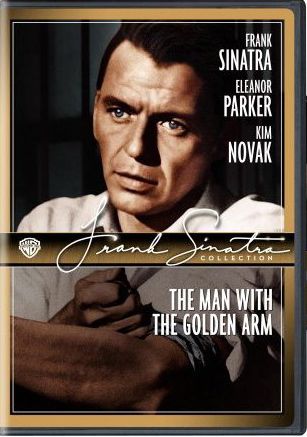
'The Man with the Golden Arm' is a 1955 drama film directed by Otto Preminger and starring Frank Sinatra, Eleanor Parker, Kim Novak, Arnold Stang and Darren McGavin.
Based on the novel of the same name by Nelson Algren, the film tells of a heroin addict who becomes clean in prison, but then struggles with temptation after his release. Former heroin addict Frankie Machine (played by Sinatra) is released from prison (where he has become clean) with a drum kit and a new lease on life. He returns to his wheelchair bound wife Zosh (played by Parker), and also runs into a former flame, Molly (played by Novak). Whilst out of jail, Frankie struggles to keep away from drugs, but later finds himself forced to deal in order to repay a debt. Watch the trailer:
The title sequence
The film's controversial title sequence, designed by Saul Bass features the an animated paper cut out of a heroin addict's arms. The purpose of the cut out was to tap into the viewers emotions, and get them ready for the mood of the film. Bass would later use a similar technique for Alfred Hitchcock films, 'Psycho' (1960), 'North by Northwest' (1959) and 'Vertigo' (1958). Watch the title sequence:
Did you know...
The Motion Picture Association of America refused to certify the film because it was about a heroin addict - the film was released without the seal of approval
Marlon Brando was also considered for the role of Frankie Machine
In preparation for the film, Frank Sinatra spent time at drug rehabilitation centres to observe heroin addicts
According to Frank Sinatra Jr., the receiving hands of the second drug dealing belong to funny man Milton Berle
Award nominations
Academy Award nomination for Best Actor (Frank Sinatra)
Academy Award nomination for Best Art Direction/Set Decoration - Black & White
Academy Award nomination for Best Music Scoring of a Dramatic or Comedy Picture
BAFTA Award nomination for Best Film from any Source
BAFTA Award nomination for Best Foreign Actor (Frank Sinatra)
Satellite Award nomination for Outstanding Classic DVD (50th Anniversary Edition)
Closing remarks
'The Man with the Golden Gun' features one of Frank Sinatra's best dramatic roles. Otto Preminger broke ground by focusing on a taboo theme, such as heroin addiction, and persisting to release the film, even after it was refused classification. It helped shape censorship laws as a year later, films were permitted to depict drug use, kidnapping, prostitution and abortion.
'Singin' in the Rain' is a 1952 MGM musical comedy directed by Gene Kelly & Stanley Donen, and starring Gene Kelly, Donald O'Connor and Debbie Reynolds with Jean Hagen, Rita Moreno, All musical numbers were choreographed by Gene Kelly.
The film is a satire on the awkward transition of silent to sound films and is most remembered for featuring Gene Kelly's signature song and dance routine 'Singin in the Rain'.
Musical program
"Singin' in the Rain" (Intro) - Gene Kelly, Donald O'Connor & Debbie Reynolds
"Fit as a Fiddle" - Gene Kelly & Donald O'Connor
"Temptation" (Instrumental)
"Dreaming Of You" - Debbie Reynolds
"Singin' in the Rain" - Gene Kelly
"Make 'Em Laugh" - Donald O'Connor
"Beautiful Girl Montage" (also features "I Got A Feeling You're Feeling", "The Wedding of the Painted Doll" and "Should I?"
"You Were Meant For Me" - Gene Kelly (with Debbie Reynolds)
"Moses Supposes" - Gene Kelly & Donald O'Connor
"Good Morning" - Gene Kelly, Donald O'Connor & Debbie Reynolds
"Would You" - Debbie Reynolds
"Broadway Melody Ballet" (also features "Broadway Rhythm") - Gene Kelly
"You Are My Lucky Star" - Gene Kelly (with Debbie Reynolds)
Deleted songs:
In an early draft of the script, "Singin' in the Rain" was to be sung by Gene Kelly, Donald O'Connor & Debbie Reynolds on their way back from the flop preview of 'The Dueling Cavalier'
In an early draft of the script Gene Kelly was to sing "Dreaming Of You", instead of "You Were Meant For Me"
Debbie Reynolds originally sang "You Are My Lucky Star" to a billboard showing an image of Don Lockwood - the footage has survived and is included on the DVD release
Rita Moreno was originally meant to sing "I Got A Feelin' You're Foolin'"
Song: "Fit As a Fiddle" - Gene Kelly & Donald O'Connor
Song: "Singin' in the Rain" - Gene Kelly, Debbie Reynolds & Donald O'Connor
Clip from 'The Broadway Ballet' - Gene Kelly & Cyd Charisse
Clip from 'The Broadway Ballet' - Gene Kelly & Cyd Charisse
"Moses Supposes" - Gene Kelly & Donald O'Connor
Outtake musical number: "You Are My Lucky Star" - Debbie Reynolds (deleted from the final film)
Song: "Would You?" - Debbie Reynolds
Song: "You Were Meant For Me" - Gene Kelly (with Debbie Reynolds)
Song: "Singin' in the Rain (in E-Flat)" / "You Are My Lucky Star" - Gene Kelly, Debbie Reynolds & Donald O'Connor (with Jean Hagen)
Did you know...
This was Debbie Reynold's first starring role
Debbie Reynolds once said the two hardest things she has ever done is childbirth and 'Singin in the Rain'
Arthur Freed gave Betty Comden and Adolph Green a mandate to write a film called "Singin' in the Rain", which was to feature as many of his songs as possible
Closing remarks
Although the film was only a moderate success on it's initial release, it is now considered to be one of the greatest musical films of all time, and even one of the best films ever made.
"This is Paris. And I'm an American who lives here" - Gene Kelly (as Jerry Mulligan in 'An American in Paris') 'An American in Paris' is a 1951 MGM musical comedy starring Gene Kelly, Leslie Caron, Georges Guétary, Oscar Levant, Nina Foch and Hayden Rourke.
Jerry Mulligan (played by Kelly) is an American painter living in Paris. His friend, Adam Cook (played by Levant) is a struggling concert pianist, and an associate of French entertainer, Henri Baurel (played by Guétary). Henri is in a relationship with Lise Bouvier (played by Caron), however things are complicated when Jerry falls in love with Lise. Meanwhile, society woman Milo Roberts (played by Foch) is interested in Jerry.
In 1993, the film was selected for preservation by the National Film Registry for being culturally, historically or aesthetically significant.
Watch the trailer:
Musical program
"Embraceable You" (Instrumental) - danced by Leslie Caron
"Nice Work If You Can Get It" - Georges Guétary
"By Strauss" - Gene Kelly, Georges Guétary & Oscar Levant
"I've Got Rhythm" - Gene Kelly
"Bidin' my Time" (Instrumental)
"Someone to Watch Over Me" (Instrumental)
"Tra-La-La (This Time It's Really Love)" - Gene Kelly & Oscar Levant
"Our Love Is Here To Stay" - Gene Kelly (with Leslie Caron)
"I'll Build a Stairway to Paradise" - Georges Guétary
"Concerto in F for Piano and Orchesta" - Oscar Levant & the MGM Orchestra
"S'Wonderful" - Gene Kelly & Georges Guétary
"An American in Paris Ballet" - Gene Kelly & Leslie Caron
Gene Kelly also recorded "I Got a Crush On You", which was deleted from the film.
Clip from 'I Got Rhythm' - Gene Kelly & the children
Song: "I'll Build A Stairway to Paradise" - Georges Guétary
Song: "By Strauss"
Song: "S'Wonderful" - Gene Kelly & - Georges Guétary
The American in Paris Ballet
In the stunning 18 minute 'An American in Paris' ballet, Kelly & Minnelli create a lavish showcase for classical ballet, tap dancing and athletic exuberance, set against the backdrop inspired by classic impressionist paintings and the amazing music of George Gershwin.
A ballet on this scale had never before appeared in an American film. The British film 'The Red Shoes' had attempted something similar a few years earlier. The ballet cost half a million dollars to stage, and took over a month to film.
I love this ballet so much, I had to include a selection of images showing its many magical moments...
Introducing Leslie Caron in her first film
Introducing Leslie Caron
'An American in PAris' was Leslie Caron's first film. While travelling in Paris, Gene Kelly noticed Leslie Caron dancing, and convinced her to return to Hollywood with him. The ironic thing was at the time Leslie Caron didn't know who Gene Kelly was.
Did you know...
Leslie Caron
Fred Astaire was also considered for the role of Jerry Mulligan
Maurice Chevalier was considered for the role of Henri Baurel
Celeste Holm was considered for the role of Milo Roberts
Cyd Charisse was considered for the role of Lise Bouvier, however she became pregnant
Marge Champion was offered the role of Lise Bouvier, however she declined as she did not want to appear without her husband, Gower Champion
Nina Foche contracted chicken pox, which put a hold on filming - this led to the idea of 'An American in Paris Ballet'
George Guetary for 2 and a half years younger than Gene Kelly, and had to have his hair greyed
Leslie Caron's film debut
Ira Gershwin sold the title of 'An American in Paris' to Arthur Freed, on the condition every song in the film must come from the Gershwin song catalogue
No dialogue is spoken in last 20-21 minutes of this film
At age 38, Gene Kelly was 19 years older than his co-star Leslie Caron
A stage adaptation followed in 2008, featuring many of the film's songs, as well as other Gershwin standards such as "They All Laughed", "Let's Call the Whole Thing Off" and "Love Walked In"
Awards and nominations
Academy Award winner for Best Picture
Academy Award winner for Best Art Direction-Set Decoration (Color)
Academy Award winner for Best Cinematography (Color)
Academy Award winner for Best Costume (Color)
Academy Award winner for Best Music, Scoring of a Picture
Academy Award winner for Best Writing, Story & Screenplay
Academy Award nomination for Best Director
Academy Award nomination for Best Film Editing
BAFTA Award nomination for Best Film from any Source
Cannes Film Festival nomination for Grand Prize of the Festival
Directors Guide of America Award nomination for Outstanding Directorial Achievement in Motion Pictures
Golden Globe winner for Best Motion Picture - Musical or Comedy
Golden Globe nomination for Best Director
Golden Globe nomination for Best Motion Picture Actor - Musical or Comedy (Gene Kelly)
National Board of Review Award winner for Top Ten Films
Writers Guild of America Award winner for Best Written American Musical
Gene Kelly was also awarded an honorary Academy Award for his "versatility as an actor, singer, director and dancer, and specifically for his brilliant achievements in the art of choreography on film" - it would be his only Oscar.
Closing remarks
A joyous celebration of ballet, French impressionist painting and Gershwin music. 'An American in Paris' is one of MGM and Gene Kelly's greatest achievements. There's not much else I can say about this film but go and watch it!
"Oooh, I need a dirty woman... Oooh, I need a dirty girl" 'Pink Floyd: The Wall' is a 1982 musical rock-opera film directed by Alan Parker, and starring Bob Geldof with James Laurenson.
Bob Geldof as Pink
'Pink Floyd: The Wall' tells of the construction and eventual demolition of a metaphorical wall: alienation. The film focuses on a central character, Pink (played by Geldof)
The film is divided into many segments, each based on a Pink Floyd song. I have structured the rest of this blog in the same way, with commentary on each segment. I have managed to find many of the segments on YouTube, and have provided links, where available to enable you to watch the segment as you read.
"When the Tigers Broke Free" (Part I) - Pink Floyd
The film opens with Pink's father (played by Laurenson) smoking a cigarette and cleaning and loading a revolver
"The Little Boy that Santa Claus Forgot" - Vera Lynn
The film cuts to a hotel corridor, as we hear a song which is not recorded by Pink Floyd.
"In the Flesh?" - Pink Floyd (with vocals by Bob Geldof)
The sequence begins with Pink sitting in a locked hotel room. The hotel housekeeper knocks, then unlocks the door with her keys. As this occurs, Pink remembers a concert, where a crowd of fans charged and opened a chained door to the concert. The stampede results in a riot where a number of people are crushed, injured and arrested. This sequence is juxtaposed with images of soldiers at war being bombed. As someone who regularly attends concerts, I can relate to the comparison of rioting fans to soldiers at war. Pink, wearing a military jacket sings to the spectator, telling us if we want to know whats going on "behind these cold eyes", we'll "just have to claw" our way "through this disguise" - this sets the expectation the character of Pink is not as he appears to be. We then witness Pink's father killed by a dive-bomber as the song ends. This is followed by the sound of a baby crying, symbolising Pink as a fatherless baby, with his widowed mother.
"The Thin Ice" - Pink Flord
The vinyl cover sleeve for "Another Brick in the Wall"
During this song, Pink is floating in a swimming pool. This image is juxtaposed by a number of wounded soldiers, which leads the water in the swimming pool to turn red, giving the appearance Pink is floating in blood. The song also acts as a transition towards Pink's early life, as the film dissolves into a flashback to the 1950s.
"Another Brick in the Wall" (Part I - Reminiscing) - Pink Floyd
Pink's mother (played by ) is at church praying, following the death of her husband as Pink plays wit a toy airplane.
"When the Tigers Broke Free" (Part I) - Pink Floyd
The reprise of this song shows Pink finding his dead father's army uniform, letter of condolence and bullets. The film shows juxtaposing shots of Pink and his father putting on the uniform.
"Goodbye Blue Sky" - Pink Floyd
This segment is animated by Gerald Scarfe, and presents a white dove which is brutally ripped apart by a black eagle. The eagle flies around leaving a trail of blood on the earth. The eagle is a metaphor for the nazi's killing the innocent, in this case the dove.
"The Happiest Days of Our Lives" - Pink Floyd
After Pink is punished by his schoolteacher, the scene cuts to the teacher in his own forced to eat tough meat. The next day, the teacher spanks a child with a belt as a form of stress release.
The faceless children in Pink's daydream
"Another Brick in the Wall" (Part II - Education) - Pink Floyd
Pink daydreams and imagines a group of students marching in a robotic-like way through a tunnel, where they re-emerge as faceless clones, before falling into an oversized meat grinder. The song ends as mince meat emerges from the meat grinder.
"Mother" - Pink Floyd
During this sequence we learn the cause of Pink's alienation was due to his strict upbringing by his overprotective mother.
"What Shall we do Now? (Empty Spaces)" - Pink Floyd
This segment is presented as an animated sequence by Gerald Scarfe. The animation begins with two flowers caressing each other, who then morph and unite similar to reproductive organs. The female flower eventually destroys the male flower - a reference to the troubled relationship Pink had with his wife, before transforming into a pterodactyl and flying off into the distance
"Young Lust" - Pink Floyd
After learning of his wife's affair, Pink is seen with several groupies, played by a young Joanne Whalley in her first debut and Jenny Wright.
"One of My Turns" - Pink Floyd
Pink brings a groupie (played by actress Jenny Wright) back to his hotel room. Thinking about his wife, Pink snaps and begins to trash his hotel room, throwing a number of objects at the groupie, and also cuts his hand after throwing a TV out of the window onto the street below.
"Don't Leave me Now" - Pink Floyd
The sequence opens back to the scene where Pink is floating in the swimming pool, which turns into blood. We are now aware of how he cut his hand. After watching some TV on his own, the shadow of Pink's wife transforms into a preying mantis, before transforming into the female flower we saw in the earlier animation.
"Another Brick in the Wall" (Part III - Drugs) - Pink Floyd
The sequence begins as Pink smashes his guitar into the TV screen. This is followed by a montage depicting the construction of the wall.
"Goodbye Cruel World" - Pink Floyd
This very short segment depicts Pink's reaction to his mental wall and acknowledges his isolation of society.
"Is There Anybody Out There?" - Pink Floyd
Largely an instrumental montage, the question "Is there anybody out there?" is asked throughout the segment as Pink attempts to reach out to someone outside of his self built wall. The segment ends as Pink shaves off his eyebrows.
"Nobody's Home" - Pink Floyd
After Pink has shaved his eyebrows, he watches more TV. The song tells of the loneliness Pink feels as a result of his isolation.
Musical program
"When the Tigers Broke Free" (Part I) - Pink Floyd
"The Little Boy Who Santa Claus Fogot" - Vera Lynn
"In the Flesh?" - Pink Floyd (vocals by Bob Geldof)
"The Thin Ice" - Pink Floyd
"Another Brick in the Wall" (Part I - Reminiscing) - Pink Floyd
"Goodbye Blue Sky" - Pink Floyd
"The Happiest Days of Our Lives" - Pink Floyd
"Another Brick in the Wall" (Part II - Education) - Pink Floyd
"Mother" - Pink Floyd
"What Shall We Do Now? (Empty Spaces)" - Pink Floyd
"Young Lust" - Pink Floyd
"One of My Turns" - Pink Floyd
"Don't Leave Me Now" - Pink Floyd
"Another Brick in the Wall" (Part III - Drugs) - Pink Floyd
"Goodbye Cruel World" - Pink Floyd
"Is There Anybody Out There?" - Pink Floyd
Two songs from the original Pink Floyd album were not used in the film: "Hey You" & "The Show Must Go On". "Hey You" was deleted due to the footage being too repetitive (most of it had already appeared in montage sequences elsewhere). The footage is available to view in black and white as a bonus feature on the DVD, under the name "Reel 13".
Did you know...
The song "When the Tigers Broke Free" was written by Roger Waters, describing the death of his father, Eric Fletcher Waters, during WWII's Operation Shingle - the song was originally supposed to feature on the Pink Floyd album 'The Wall', but was rejected by other band members for being too personal
A young Joanne Whalley appears as a Groupie in her film debut
In the song "One of my Turns", Bob Geldof really cut his hand on the shard of glass - director Alan Parker continued filming
Although the film's end credits refers to a soundtrack album from Columbia Records, all that was released was a single containing "When the Tigers Broke Free" and a re-recorded version of "Bring the Boys Back Home"
Awards
British Academy Award winner for Best Original Song ("Another Brick in the Wall")
Closing remarks
Although I am not a fan of Pink Floyd or their music, I like this film a lot. I really like the way Alan Parker has accompanied an existing work of music with visual poetry. Parker would later show us his talent in telling a story with music and images with 'Evita' (1996).


.jpg)